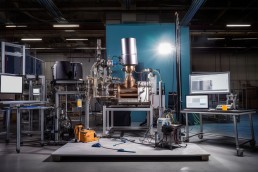
In today’s rapidly changing market, manufacturers are grappling with the need for versatility in managing manufacturing resources and their production lines. Flexible Manufacturing Systems (FMS) offer a revolutionary solution, born from the innovative work of Jerome H.Lemelson in the early 1950s.
This guide will unlock FMS benefits and strategies, helping you streamline your production operations for maximum efficiency. Discover how flexibility can be your factory floor’s greatest asset.
Key Takeaways – Flexible Manufacturing System
Flexible Manufacturing Systems (FMS) offer manufacturers the ability to quickly adapt production lines, handling various products with minimal downtime.
Investing in an FMS means higher upfront costs but can lead to significant long – term savings through improved efficiency and reduced labour costs.
Successful implementation of an FMS requires careful planning, skilled technicians, and thorough training for staff to ensure smooth operation and transition.
While highly advantageous for customisation and responsiveness to market changes, FMS setups may have complexities that demand meticulous design and can involve a steep learning curve for teams.
Directors must evaluate their manufacturing objectives against the potential challenges of adopting an FMS to decide if it aligns with their company’s long-term goals.
Understanding Flexible Manufacturing Systems (FMS)

Delving into the realm of Flexible Manufacturing Systems (FMS) reveals a transformative approach to flexible production systems, where agility meets precision in the modern factory setting. This section illuminates the core concepts and varied architectures that underpin FMS, offering insight into how they redefine manufacturing efficiency and adaptability.
Definition and Working Principle
Flexible Manufacturing Systems (FMS) stand as a modern solution to the ever-changing demands of production. They allow factories to switch between different products without significant downtime, making them especially valuable in today’s fast-paced markets manufacturing industries.
The core principle behind an FMS is its adaptability; machines typically operate using Computer Numerical Control (CNC), a computer control which directs their actions with precision. This set-up enables quick reconfiguration for new tasks, guided by a central control computer that acts much like the human brain coordinates the body.
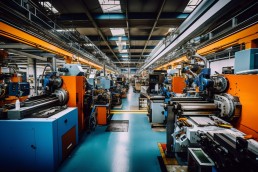
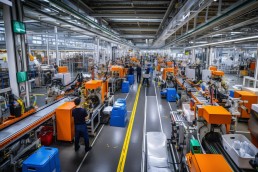
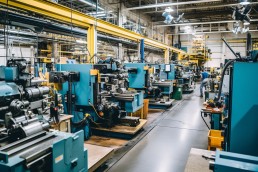
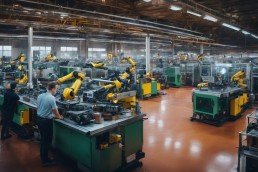
At each workstation within an FMS, you might see automated CNC machines, mills and lathes going about their work, all seamlessly integrated through advanced communications networks for efficient data transmission.
The smart coordination between varied machinery – linked by automated material handling systems such as automatic guided vehicles – is what gives material handling system and an FMS its flexibility and reliability.
Now moving forward, let’s delve into the various types of FMS that can be implemented on factory floors.
Types of FMS
Dedicated FMS: A system configured for the production of a specific type of product or part. Whilst focused on particular operations, it still maintains some level of adaptability for slight variations. Companies often use dedicated FMS when they have long-term contracts or consistent demand for certain products.
Random Order FMS: This is equipped to handle a mix of different products in no set sequence. It’s ideal for manufacturers dealing with variable customer demands, offering the agility needed to switch between tasks seamlessly.
Engineered FMS: Specially designed around a family of parts with similar requirements. These systems are optimised for groups of products that share processing sequences, making them perfect for industries like automotive components where parts may differ but undergo similar stages of fabrication.
Modular FMS: It features independently operated modules that can be easily interchanged or replaced. This setup provides businesses with the ability to upgrade individual parts without overhauling the entire system, saving time and resources.
Advantages and Disadvantages of FMS

Exploring the multifaceted nature of Flexible Manufacturing Systems (FMS) reveals a spectrum of advantages, tailored to enhance production efficiency routing flexibility and adaptability. However, these advancements come with their unique set of challenges, necessitating a thorough evaluation for any organisation looking towards its adoption.
Benefits of FMS
Enhanced Efficiency: The FMS system streamlines the manufacturing process by minimising downtime. Machines swiftly switch between tasks without halting production, thus significantly boosting output rates.
Customisation Capability: Directors will appreciate how FMS supports a make-to-order approach. This system adapts easily to produce bespoke products on demand, which helps maintain low stock levels.
Labour Cost Reduction: Automation is integral to an FMS’s operation. It strategically reduces human intervention, cutting labour expenses and allowing redeployment of staff to other value-adding activities.
Production Flexibility: Machine flexibility within an FMS means that manufacturers can respond rapidly to changes in product design or customer needs without extensive delays or retooling costs.
Lower Production Costs: Over time, the cost benefits become clear as the initial investment in an FMS leads to savings in materials, waste reduction, and energy efficiency.
Consistent Quality Control: Automated systems within an FMS have superior precision. Consistently high-quality products emerge due to reduced human error and computer-controlled processes.
Agile Response to Market Changes: An FMS equips directors with the ability to quickly adapt their production lines for new products or modifications due to its modular design.
Drawbacks of FMS
While the benefits of Flexible Manufacturing Systems (FMS) are significant, implementing such a flexible manufacturing system definition comes with its own set of challenges. Directors need to weigh these drawbacks against the advantages to make informed decisions for their manufacturing operations. Here’s a closer look at some of the obstacles that might be encountered:
High Initial Costs: The upfront investment for setting up an FMS is substantial, often much higher than conventional manufacturing setups. This includes expenses for state-of-the-art CNC machines, sophisticated software, and integrating computerised systems into the production line.
Complexity in Design: Crafting an FMS that meets diverse requirements demands meticulous planning and engineering. The design process can be time-consuming as it requires anticipating future needs and ensuring system adaptability.
Demand for Skilled Technicians: An FMS operates with advanced technology that requires human operators to have specific skills. Hiring and training personnel with expertise in computer-integrated manufacturing and real-time system monitoring is essential but can be difficult and costly.
Adjustment Phase: Transitioning from traditional manufacturing methods to an FMS could involve a steep learning curve for staff members. This adjustment phase may lead to temporary slowdowns or a dip in productivity as employees familiarise themselves with new machinery and protocols.
Risk of Over-Complexity: While designing an FMS to handle multiple tasks, there’s the risk of creating excessive complexity, making it harder to maintain efficiency and control over operations.
Dependence on Technology: A heavy reliance on computers and automation means that technical failures can bring production to a standstill. Ensuring robust back-up systems and maintenance plans is critical but adds to operational costs.
Implementing FMS

Implementing an FMS requires meticulous planning and a strategic approach tailored to the unique needs of each manufacturing environment. Discover how embracing this system can revolutionise your production process, escalating efficiency system flexibility and adaptability in a competitive industrial landscape.
Strategies for Setting Up an FMS
Evaluate your current manufacturing needs and objectives to determine how an FMS can align with your company’s goals. Consider factors such as product variety, volume and customisation options that an FMS could support.
Identify the right type of FMS for your operations. Whether you choose a dedicated, modular, or random-order system depends on the level of flexibility and automation required.
Consult skilled technicians who understand both the technical aspects of FMS and its practical applications in manufacturing environments.
Develop thorough training programmes for staff who will operate and maintain the new systems, thus ensuring smooth transitions and continuous operation.
Incorporate advanced numerically controlled machines to heighten precision in production processes.
Design an adaptable topology within your plant layout to accommodate new equipment without major disruptions.
Establish real-time data visualisations to monitor production processes closely, enabling quick response to any issues or changes needed.
Assess financial modelling to project costs and returns on investment for implementing an FMS, assisting in informed budgeting decisions.
Analyse market trends in digital marketing and equity research to predict future demands that could influence the design of your FMS.
Automate material handling systems within the FMS setup to improve efficiency and reduce human error during production stages.
Comparing FMS to Other Manufacturing Methods
To effectively gauge the cost savings efficacy of Flexible Manufacturing Systems (FMS), we need to measure them against traditional and other modern manufacturing methods. This comparison helps directors understand why an investment in FMS might be beneficial for their operations.
| Feature | Flexible Manufacturing System (FMS) | Traditional Manufacturing | Just-In-Time (JIT) | Lean Manufacturing |
|---|---|---|---|---|
| Adaptability | Highly adaptable to changes in product type and volume | Low adaptability; changes require significant downtime | Adaptability is moderate; focused on reducing inventory | Adaptable through continuous improvement but can be process-specific |
| Automation Level | High automation, with computer-controlled workstations | Varies, but generally lower automation with more manual labour | Automation is used but not as extensively as in FMS | Automation is balanced with workforce engagement |
| Cost Efficiency | Reduces labour costs and increases production efficiency | Higher labour costs and potentially less efficient | Cost savings through inventory control and waste reduction | Emphasises waste reduction and value stream mapping for cost-saving |
| Customisation | Facilitates make-to-order strategy with customised products | Limited customisation due to fixed tooling and setups | Not ideal for customisation; aims for uniformity and pull system | Flexibility for customisation exists but is not a primary focus |
| Inventory Management | Low inventories due to batch production capabilities | Typically requires high inventory levels | Minimal inventory to match production to consumption | Focused on reducing inventory to essential levels only |
| Response Time | Quick response to market changes and customer demands | Slower response time due to lack of flexibility | Efficient response through streamlined workflows | Responsive through elimination of non-value-added activities |
| Investment | Higher initial investment but long-term savings | Lower initial investment but potentially higher operational costs | Varied investment; cost-saving in inventory management | Investment in training and process improvements |
| Production Volume | Ideal for medium to high variety and low to medium volumes | Best suited for high volume, low variety production | Designed for continuous flow at a rate determined by demand | Optimised for value streams, not necessarily high volume |
An FMS offers unprecedented levels of flexibility and efficiency, particularly when compared to traditional manufacturing methods. It excels in customisation and quick market response, making it a formidable strategy in today’s competitive landscape. However, directors must weigh the higher initial investment against potential long-term gains when considering the shift to an FMS production method.
Conclusion
Flexible Manufacturing Systems stand at the forefront of modern industry, embodying innovation and efficiency. In a world where customisation is king, FMS ensures manufacturers remain agile and responsive to market demands.
Leaders in production must consider FMS as a strategic investment that can drive their operations towards greater productivity, improved quality and profitability. It’s clear that embracing such systems may very well define the competitive edge needed in today’s fast-paced manufacturing arena.
With careful planning and execution, implementing an FMS can transform challenges into opportunities for growth and success.
FAQs
1. What exactly is a Flexible Manufacturing System (FMS)?
A Flexible Manufacturing System, or FMS, is an industrial production system, that allows for the easy swapping of parts and tools to produce different products without halting the entire assembly line.
2. Can you define what flexible manufacturing means?
Flexible manufacturing refers to the system’s ability of factories to adapt and change their production lines quickly and efficiently in real-time, much like how the brain controls various functions of the human body.
3. Why should companies consider implementing an FMS?
By automating their production processes with an FMS, companies can achieve mass production efficiency and maintenance costs while still being able to produce items according to specific customer demands at lower costs.
4. How does a CNC lathe fit into a Flexible Manufacturing System?
In a flexible manufacturing system, machines like CNC lathes are used because they can be programmed to perform precise tasks on different materials – making them essential for versatile machining needs.
5. Are there any economic benefits from using an FMS?
Yes! An automated storage efficient FMS can help manufactures reduce waste, save time by producing files swiftly and improve overall productivity which may positively impact corporate finance by streamlining economics and budgetary considerations.
6. What strategies should businesses follow when integrating Flexible Manufacturing Systems?
Businesses looking to integrate an FMS should conduct thorough equity research analysis for valuations on investment returns, plan with statistics regarding workflow improvements and ensure staff understand protocols such as CSMA/CD or token ring/buses commonly found within these systems.
And there's more...