Manufacturers often grapple with the challenge of understanding complex production processes. Discrete manufacturing stands as a pivotal method in today’s industrial landscape, involving distinct, countable finished products.
This article will unravel the intricacies of discrete manufacturing vertical markets and provide clear examples to guide industry directors. Discover how discrete manufacturing vertical markets how it shapes our world, and includes make to stock, piece by piece.
Key Takeaways
Discrete manufacturing is about producing distinct, countable products like cars and electronics, allowing for individual tracking and quality control.
Key components in discrete manufacturing include a Bill of Materials (BOM), production routing, assembly lines, and strict quality control systems to maintain high standards.
Software tailored for discrete manufacturing can significantly enhance efficiency by integrating quality requirements, optimising supply chain synchronisation, and providing clear shop floor transparency.
Industries such as automotive, aerospace, electronics, and consumer goods heavily rely on discrete manufacturing methods to meet the precise demands of their customers.
The flexibility of discrete manufacturing allows companies to tailor products quickly to customer specifications and adjust production plans rapidly in response to market changes.
Defining Discrete Manufacturing

Discrete manufacturing crafts items in bulk quantities that are each complete and distinct, such as cars, toys, furniture or aeroplanes. This type of production stands apart in its ability to produce bulk quantities of individual units with specific tracking numbers, making it easier for businesses to assess inventory levels and meet customer demands.
Manufacturers can halt production at any stage if necessary to ensure that each item meets stringent quality standards before reaching the market.
Within this realm fall mid sized discrete manufacturers and process manufacturers who specialise in original components in areas like automotive or consumer electronics – sectors reliant on the process manufacturers assembling numerous individual components together into a finished product.
These producers often operate on a make-to-order basis, ensuring products are tailored to exact specifications demanded by their clients. With a focus on precision and customisation, discrete manufacturing aligns closely with innovation and adaptability in today’s fast-paced industrial landscape.
The Building Blocks of Discrete Manufacturing

Understanding the core components of discrete manufacturing is essential for any director looking to optimise production and maintain competitive advantage. These elements serve as the foundation that dictates workflow efficiency, product quality, and ultimately customer satisfaction in industries driven by unit-based outputs.
Bill of Materials (BOM)
A Bill of Materials (BOM) is vital for directors overseeing discrete manufacturing processes. It details every part, component, and assembly required to create a finished product. Think of it as the recipe that tells your production team precisely what raw ingredients they need and in what quantities.
From tiny screws to major assemblies, the BOM lists them all.
Having a robust BOM system ensures that you manage raw materials effectively and helps predict costs accurately. MRPeasy excels here with an advanced bills of materials functionality designed to support the complexities of discrete manufacturing.
This tool assists in minimising waste, streamlining inventory management, and simplifying procurement – essential elements for maintaining cost-effectiveness in competitive markets.
By leveraging this aspect of ERP software systems like MRPeasy, companies can maintain high standards across their operation’s many moving parts while meeting customer demand efficiently.
Production Routing
Production process routing is the roadmap for the process of manufacturing a discrete product, the process is detailing every step of manufacturing process, from start to finish. It outlines the full process and sequence of operations that must occur to transform raw materials into finished goods.
This clarity ensures each department or work centre knows precisely what task they need to perform and when, streamlining production and reducing bottlenecks. The preciseness of each operation, including setup hours and total queue/move hours, is critical in calculating lead times.
Effective routing goes beyond simply listing steps; it optimises the flow within your discrete manufacturing process. Through meticulous planning, companies create efficient paths that minimise waste and expedite throughput.
Such strategies also facilitate responsiveness to engineering changes, thanks to an established framework that can be quickly adjusted as needed. Optimising both these manufacturing types and sequences contributes significantly toward shorter lead times which are essential for maintaining competitiveness in fast-paced markets like automotive or electronics industries where demand fluctuates rapidly.
Assembly Line
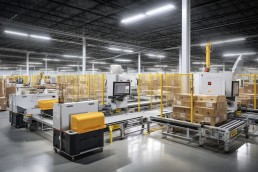
The assembly line stands at the heart of discrete manufacturing, revolutionising the way products are made. It transforms the process manufacturing production by moving items systematically from one workstation to another, each step performed by skilled professionals or advanced machinery adding to the completeness of an item.
Coordinated precision along these lines not only speeds up manufacture but also ensures consistency in quality across batches.
Utilising this method allows for a more streamlined workflow where individual tasks are optimised for both time and resource efficiency. Manufacturers can more easily manage safety and track progress at every stage, spotting bottlenecks swiftly and responding with rapid course corrections.
This focus on order production and continuous flow aligns neatly with the demands of discrete industries where mass production needs to meet high standards while adapting to market changes.
Quality Control Systems
Quality control systems are essential components in the realm of discrete manufacturing, ensuring that every product meets the strictest quality standards. These rigorous systems evaluate raw materials, parts, and finished goods to catch defects before items reach customers.
They dramatically reduce waste, cut down on costs, maximise profits, increase profits and drive efficiency across your operations. Implementing measures like Six Sigma or Total Quality Management can transform production lines into bastions of excellence.
Manufacturers deploy a variety of these systems for optimal results – statistical process control tracks performance data in real-time while lean manufacturing principles focus on minimising excess.
Directors should note how these systems not only safeguard one company against errors but also bolster productivity. By embracing quality management tools essential practices within your enterprise resource planning (ERP) framework, you create a robust foundation for consistent output and heightened consumer satisfaction.
Discrete Manufacturing vs. Process Manufacturing
In exploring the landscape of discrete manufacturing and process manufacturing it is crucial to distinguish the difference between the two, both of which cater to vastly different product types and industrial methodologies.
This contrast not only determines production techniques but also shapes the logistical frameworks within which these industries operate.
Fundamental Differences
Discrete manufacturing and process manufacturing stand apart in their core operations. Where discrete manufacturing is about piecing together distinct units, think cars or appliances, process manufacturing blends together to combine raw materials and ingredients together to produce items like chemicals or food.
Each type has its own set of challenges, critical processes and requirements. Discrete manufacturers focus on the assembly of products, often involving meticulous production routing and detailed Bills of Materials (BOMs).
They thrive on creating intricate items with several components that fit together in a specific sequence. On the other side, in process manufacturing, manufacturers mix substances to achieve a consistent final product after batch production.
Continuous flow production and batch processing dominate this space – activities distinctly different from the unit by unit assembly seen in the difference between discrete and process manufacturing settings.
Their software must accommodate variations in formulae while managing quality across vast quantities without deviation; whereas discrete manufacturing ERP software systems target material handling, machining precision, and efficient assembly processes.
These fundamental differences dictate not just operations but also how industries approach inventory management, supply chain management, logistics, regulatory compliance, and real-time data analysis for key performance indicators (KPIs).
Market Associations and Applications
Automotive Industry: This sector relies heavily on discrete manufacturing for the assembly of automobiles which are constructed from multiple parts such as engines, body panels, and electronic systems. Automotive companies leverage production planning tools and advanced software like ERP (Enterprise Resource Planning) systems for efficient operations management.
Aerospace Sector: Here, precision is paramount; hence discrete manufacturers produce highly specialised components for aircraft. They utilise project management software to keep track of complex production schedules and ensure that each piece meets rigorous quality standards.
Electronics: Manufacturers in this domain create discrete products ranging from small gadgets to large mainboards. Supply chain management systems are crucial here to coordinate the myriad of suppliers providing different electronic components.
Consumer Goods: The diverse product requirements in this industry push companies towards flexible manufacturing processes capable of handling various items like packaging materials, apparel or household appliances. Manufacturers employ kanban cards and just-in-time inventory strategies to meet consumer demand without excessive stockpiling.
Advantages of Discrete Manufacturing

Discrete manufacturing stands out for its ability to adapt swiftly to market demands and tailor products to specific customer requirements. It offers manufacturers enhanced control over inventory, minimising waste and optimising storage costs.
Flexibility in Production
Discrete manufacturing stands out for its dynamic ability to adapt swiftly to market demands and design alterations. This flexibility is pivotal in today’s fast-paced business landscape where the capacity to respond rapidly can be the difference between leading or lagging behind competitors.
Advanced technology, including cutting-edge software solutions and automated systems, bolsters this agility in production processes, empowering companies to adjust their output with ease and maintain a competitive edge.
Manufacturers in discrete industries benefit immensely from such nimble operations, as they can scale up or pare down production runs without compromising efficiency or lead times.
Tailoring products to customer specifications becomes less of a challenge and more of an opportunity for differentiation. With these robust systems firmly in place, businesses possess the capability not only to manage but also flourish amidst continual change and diverse consumer preferences.
Ease of Customisation
Manufacturers in discrete industries gain a competitive edge with the adaptability of their production processes. Easy customisation means they can swiftly cater to unique customer requirements and niche markets, ensuring a broader reach and increased satisfaction.
This agility is paramount for staying relevant as consumer preferences shift and new trends emerge.
Microsoft Dynamics 365 stands at the forefront of facilitating this dynamic environment by enabling meticulous production planning and efficient resource management. The resulting streamlined workflow allows manufacturers to implement custom orders without disrupting standard operations, keeping businesses ahead in fast-paced sectors like electronics and automotive.
Moving on to inventory control, companies find yet another layer where discrete manufacturing shines, offering precise oversight over stock levels and component use.
Inventory Control
Inventory control stands as a cornerstone in discrete manufacturing, ensuring the delicate balance between too much and too little is maintained. Effective management of this aspect can drastically reduce lead times, enabling directors to synchronise supply with customer demand accurately.
It requires meticulous tracking of raw materials and finished goods to prevent overstocking which ties up capital unnecessarily. With tools like Dynamics 365, handling inventories becomes streamlined; resources are leveraged efficiently to bolster productivity across production lines.
Minimising excess inventory through strategic control translates into direct economic benefits for manufacturing companies. The key lies in leveraging data-driven insights to inform production scheduling process manufacturing decisions that align with market dynamics.
Addressing this effectively paves the way for exploring how discrete manufacturing powers various industries – from automotive ventures where precision part stocking is crucial, to electronics sectors thriving on rapid innovation cycles – each necessitating robust inventory controls tailored to their unique demands.
Moving forward, let’s delve into how these practices are adopted within different industrial landscapes.
Discrete Manufacturing in Various Industries
Discrete process manufacturing serves as the backbone of a myriad of industries, each leveraging industry specific solutions with process manufacturing and its precise and flexible production tools essential methods for process manufacturers to move high volumes and make to order and create distinct items with high value. The versatility inherent in this approach process manufacturing can be observed across all manufacturing types critical processes and sectors, where it enables the fabrication process manufacturing of complex components tailored to industry specific solutions and the exacting standards demanded by automotive engineering, innovative electronic devices, high tech, and cutting-edge aerospace technology.
Automotive
Discrete manufacturing process in the automotive sector stands out as a highly intricate manufacturing process. It demands meticulous coordination of numerous components, quite akin to aircraft production.
Central to this operation is the seamless integration of supply chain management, which ensures all parts arrive just in time for assembly. Manufacturers rely on a detailed bill of materials and precise production routing to maintain efficiency across complex assembly lines.
Employing ERP software becomes indispensable within this industry, addressing core bills of material operations, fluctuating demands, and integrating CRM systems meticulously. This new technology streamlines after-market services alongside field service management, contributing significantly to customer satisfaction and loyalty.
To remain competitive in such a dynamic environment requires embracing flexible manufacturing systems backed by robust inventory control measures that aim at curtailing lead times while minimising waste – an essential strategy for any modern auto manufacturer concerned with both profitability and sustainability.
Electronics
Transitioning from the precise and structured world of automotive manufacturing, electronics manufacturing presents its own unique set of challenges and opportunities. This sector demands meticulous assembly processes to combine individual components into sophisticated electronic devices that power today’s connected world.
Electronics manufacturers must keep pace with rapid technological advancements while ensuring product quality and consistency.
Microsoft Dynamics plays an integral role in this dynamic industry by providing a Gantt chart product view that supports meticulous operational planning for electronics manufacturers. This allows teams to track production schedules effectively and respond swiftly to any changes or disruptions on the floor.
Moreover, Dynamics 365 enhances team collaboration, connecting office personnel with those on the assembly line – a critical factor in swift decision-making and project success within any high-paced electronics factory environment.
Aerospace
The aerospace industry showcases the precision of the discrete manufacturing process as it crafts each aeroplane and spacecraft through meticulous assembly. This sector is a prime example of how unit production, as opposed to bulk processing, delivers products with unparalleled complexity using diverse inputs.
Meticulous planning ensures every component meets stringent standards while minimising waste and streamlining inventory. In crafting these high-value assets, the synergy between advanced computer-aided design and the implementation time robust quality management systems plays a crucial role.
Seamless coordination with suppliers contributes significantly to maintaining rigorous production schedules in aerospace discrete manufacturing. As directors overseeing complex operations, understanding this integration can lead to enhanced customer satisfaction through reliable deliveries of top-tier aircraft and related products.
Ensuring efficiency across all levels paves the way for discussions on the impact of software solutions -a key factor in modernising discrete manufacturing practices.
The Role of Software in Discrete Manufacturing
Discrete manufacturing software revolutionises operation efficiency, seamlessly integrating complex processes to deliver unprecedented levels of productivity – discover its transformative power in our next section.
Features and Benefits of Discrete Manufacturing Software
Discrete manufacturing software stands as a transformative tool for today’s industry leaders. It not only streamlines operations but also fosters innovation and responsiveness within the market.
Integration of Quality and Regulatory Requirements: The software seamlessly blends regulatory standards and quality measures into the manufacturing workflow. This integration ensures products meet industry specifications, reducing risk of non-compliance and elevating product integrity.
Synchronisation Across the Supply Chain: Real-time data allows for the precise coordination of production activities with suppliers, distributors, and customers. Such synchronisation minimises downtime and enhances productivity throughout the supply chain.
Shop Floor Transparency: Operators gain complete visibility over the manufacturing floor, facilitating immediate responses to emerging issues or changes in demand. This clear oversight is pivotal in maintaining continuous operational flow.
Optimised Manufacturing Sequences: Advanced algorithms organise production schedules efficiently, prioritising tasks to maximise throughput while minimising resource wastage.
Instant Access to Production Documentation: Immediate retrieval of necessary documents accelerates decision-making processes. This feature ensures that production can adapt swiftly to new requirements or alterations in design.
Flexible Production Planning: Enhanced planning capabilities provide directors with the tools to adjust manufacturing processes quickly. Adaptation to market shifts becomes simpler, ensuring companies remain competitive.
Resource Management Efficiency: Proper management of materials, labour, and machinery maximises output while conserving resources. Directors can oversee these elements effectively through comprehensive discrete manufacturing ERP systems.
Comprehensive Quality Management Systems (QMS): Incorporating QMS modules within the software helps maintain high standards across all stages of production. Consistent product quality leads to higher customer satisfaction rates.
Lower Production Costs: By automating various aspects of production and reducing manual intervention, companies can significantly cut down on operational expenses.
How Software Enhances Efficiency and Productivity
Software stands at the forefront of optimising discrete manufacturing processes. It streamlines production planning and resource management, allowing for real-time adjustments that keep operations running smoothly.
With centralised data hubs provided by modern, ERP software systems, decision-makers gain immediate access to critical information that helps reduce bottlenecks and accelerate workflows.
Manufacturing execution systems (MES) adapt to shifts in materials, markets, and product complexity with agility. They afford manufacturers a striking advantage: the ability to contend with an ever-evolving industry landscape without compromising on quality or lead times.
Drawing on capabilities such as computer-aided design (CAD) and manufacturing operations management (MOM), these software tools are essential in meeting customer demands while minimising costs, enhancing not only efficiency but also productivity across supply chains.
Discrete vs. Continuous Manufacturing
Understanding the dichotomy of difference between: discrete manufacturing and continuous manufacturing is pivotal for directors looking to optimise their production strategy. The contrast can influence everything from workflow management to capital investment. Here, we crystallise the fundamental differences between these two types of manufacturing.
| Discrete Manufacturing | Continuous Manufacturing |
|---|---|
| Pertains to the production of distinct items that can be counted, touched, and seen as individual units. | Involves the uninterrupted production of goods, resulting in products that can’t be broken down into distinct units without altering their nature. |
| Assembly lines are typical, where components are assembled to create a finished product. | Characterised by a constant flow of materials through a pipeline or tube, often found in chemical processing. |
| Markedly prevalent in automotive, electronics, and consumer goods industries. | Common in industries like chemical processing and oil refining, producing items such as fuels and plastics. |
| Can be customised to allow for the production of unique and individualised products. | Typically results in uniform and homogenous products, with less scope for customisation. |
| Offers flexibility and can adapt to changes in demand and market trends through agile production methods. | Operates best with a steady, consistent demand for standardised products. |
| Examples include the production of smartphones, automobiles, and furniture. | Examples extend to the production of chemicals, fuels, and plastics. |
| Automation employs advanced technology and robotics to optimise assembly and production processes. | Relies heavily on strict control of process conditions to ensure product quality and consistency. |
Directors must consider both these manufacturing types and aspects to make informed decisions that align with their company’s goals and the nature of their product offerings. Choosing the right manufacturing type can define a company’s ability to respond to market demands and maintain competitive advantage.
The Impact of Discrete Manufacturing on Supply Chain
Discrete manufacturing shapes every aspect of the supply chain, from inventory management to the final product and distribution. It demands precise coordination between sourcing raw materials, scheduling production runs, and ensuring timely order fulfilment.
Managers must juggle complex variables; a task made easier with project management software designed for discrete industries. This technology can greatly improve communication and efficiency across all stages of operations.
Supply chain performance is significantly enhanced through the strategic integration of discrete manufacturing systems. These include advanced planning solutions that align master production schedules with real-time demand forecasts.
Implementing such tools ensures a more responsive and adaptable supply chain, capable of meeting customer needs swiftly while maintaining optimal inventory levels. Every link in this intricate network directly benefits from improved visibility and control over discrete manufacturing processes.
Conclusion
As we delve into the intricacies of discrete manufacturing, clarity emerges on discrete manufacturing focuses its pivotal role across diverse industries. It shapes products that power our lives, from cars to computers.
Armed with this knowledge and necessary tools and financial management tools, directors can now steer financial management of their factories towards more efficient and innovative production frontiers. Embrace these insights to enhance operations and seize competitive advantage in a dynamic market.
Harnessing the power of discrete manufacturing paves the way for excellence in production and product management.
FAQs
1. What does discrete manufacturing mean?
Discrete manufacturing refers to the production of distinct items, like computer keyboards, mobile phones and farm equipment, which can be easily counted, touched and seen.
2. How does discrete manufacturing differ from process manufacturing?
Discrete manufacturing involves assembling products from individual parts such as machine tools or motherboards, while process manufacturing blends materials to create a product like spray or steel that cannot be disassembled.
3. Can you give an example of a product made by discrete manufacturers?
An example of a product from discrete manufacturers is metal fabrication; they shape and combine raw materials and metals into precise components used in various industries.
4. What software do companies use in discrete industries?
Companies use specialised ERP software (Enterprise Resource Planning) systems built specifically for discrete manufacturing with modules for CAD (Computer-Aided Design), CRM (Customer Relationship Management), QMS (Quality Management System), and more to manage their operations effectively.
5. Why are metrics important in the context of understanding discrete vs continuous manufacturing processes?
Metrics are vital for capacity planning and maintenance in both types of manufacturing processes -discrete versus continuous – helping businesses monitor workload, efficiency ratios like percentage utilisation, and identify improvement areas.
And there's more...